

Table of Contents
- How to Measure Yourself for Dresses Online
- How to Spot Fake Online Clothing Stores
- Online Boutique Return Policy Best Practices
- Secure Payment Methods and Fraud Prevention When Buying Dresses Online
- Fabric Composition, Garment Care, and Quality Verification
- Visual Search, AI Sizing Tools, and International Shipping Risks
- Frequently Asked Questions
Last Updated: September 12, 2026
How to Measure Yourself for Dresses Online
The single biggest reason online dress orders go back is size, not style. According to UX Planet's online clothing UX case study, size and fit issues are the primary reasons shoppers return clothing bought online. At Swagg Bootique LLC, we hear the same thing from customers: the dress was gorgeous, but it pulled at the bust or gaped at the waist. Learning to measure yourself properly is the foundation of tips for buying dresses online safely, and it takes about five minutes.
The Three Measurements That Matter Most
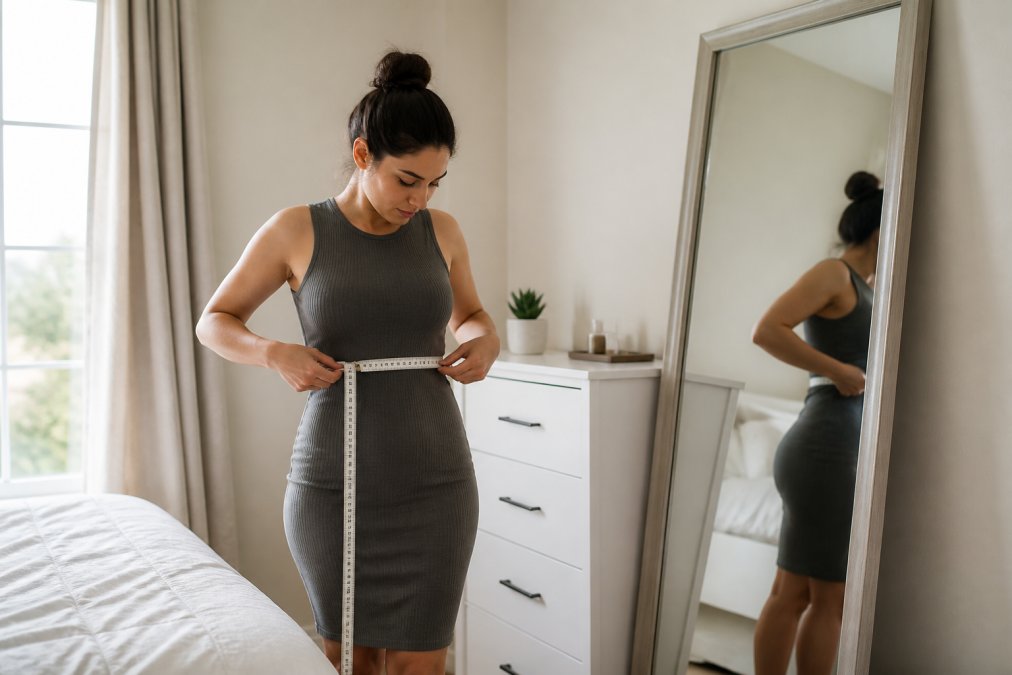
Bust, waist, and hips determine dress fit. Measure over thin clothing or a fitted base layer, never a bulky sweater.
- Bust: Measure around the fullest part of your chest, keeping the tape level and snug but not tight.
- Waist: Find your natural waist, the narrowest point above your belly button, and measure there.
- Hips: Measure around the fullest part of your hips, usually 7 to 9 inches below your waist.
Write the numbers down and remeasure once. A half-inch error is common on a first pass.
Reading Size Charts Without Guessing
A size chart is a brand's own fit guide and does not transfer between retailers: a medium at one boutique can measure like a small at another, so match your numbers to that store's chart. If your bust and hips land in different sizes, size up and plan for alterations. Skip the "order three sizes and return two" habit, it raises shipping and return costs.
Pro Tip
Measure yourself at the end of the day, not first thing in the morning. Bodies shift slightly through the day, and evening measurements tend to match how a dress will actually fit when you're out wearing it.
How to Spot Fake Online Clothing Stores
Fake storefronts copy real brands' photography and pricing to harvest card details, then disappear within weeks. Two quick checks catch most of them before checkout.
Website Security Checks That Take Two Minutes
A legitimate store uses a secure checkout with a valid SSL certificate, shown by the padlock icon and an address starting with https://. Click the padlock and confirm the certificate matches the store's actual domain. Then check for the basics every real retailer publishes: a physical mailing address, a working phone number or email, an about page, and a privacy policy. Hidden contact information or a web form only is a red flag.
Counterfeit Photography and Too-Good-to-Be-True Pricing
Counterfeit sellers rarely shoot their own photos; they lift high-resolution images from real brands, which is why the same picture can appear on three different websites. Reverse-image search a few photos, if they trace back to a different brand, it's a scam. Pricing is the second tell: a designer-look dress at a fraction of retail is bait, not a bargain.
Watch Out
If a store only accepts payment by wire transfer, gift card, or cryptocurrency, walk away. Those methods offer no chargeback protection, and once the money leaves your account, there is no way to recover it.
Online Boutique Return Policy Best Practices
A fair return policy is the difference between a low-risk purchase and a gamble. Before you add a dress to your cart, read the return and exchange terms in full: online boutique return policy best practices start with knowing the rules before you buy.
What a Fair Return Policy Actually Looks Like
A reasonable policy gives you a clear delivery window, a stated return timeframe (14 to 30 days is standard), and a defined process for requesting a return. Look for these elements:
| Policy Element | Fair Terms | Red Flag |
|---|---|---|
| Return window | 14-30 days from delivery | Under 7 days or none stated |
| Restocking fees | None or clearly disclosed | Hidden fees revealed at return |
| Final sale items | Clearly labeled before purchase | Unmarked, discovered after |
| Refund method | Original payment within 5-10 days | Store credit only, no cash option |
| Return shipping | Reasonable and disclosed | Costly, undisclosed charges |
Restocking Fees, Final Sale, and Your Rights
Restocking fees, typically 10 to 20 percent, are legal in most states as long as the seller discloses them before purchase. Final sale means no return, so only buy final-sale items when you're confident in the fit. If a store refuses a legitimate return that its own policy allows, you have recourse: dispute the charge with your card issuer, and know that the FTC's guidance on online shopping and your rights outlines what sellers must disclose about refund and delivery terms.
Secure Payment Methods and Fraud Prevention When Buying Dresses Online
The safest way to pay is with a credit card, because federal law caps your liability for unauthorized charges and gives you a formal dispute process. Debit cards, wire transfers, and peer-to-peer apps offer far weaker protection.
Why Credit Cards Beat Every Other Payment Method
Under the Fair Credit Billing Act, your liability for unauthorized credit card charges is capped at $50, and most major card networks waive even that. Debit cards fall under the Electronic Fund Transfer Act: the money leaves your checking account immediately, so you fight to get it back rather than disputing an unpaid charge. That timing difference matters when a fake storefront has already vanished.
Here's how the methods stack up for a dress purchase:
| Payment Method | Dispute Window | Your Liability | Money Out of Pocket? |
|---|---|---|---|
| Credit card | 60 days from statement | Capped at $50 by law | No, until the bill is due |
| Debit card | 60 days, but funds already gone | Capped, but recovery is slower | Yes, immediately |
| PayPal Goods & Services | 180 days | Full protection if eligible | No |
| Wire transfer | None | Total loss | Yes, irreversibly |
| Gift card / crypto | None | Total loss | Yes, irreversibly |
PayPal's Goods & Services protection covers eligible purchases for 180 days, longer than most card issuers allow, but you must use Goods & Services, not Friends & Family. A seller who asks you to pay as Friends & Family to 'avoid fees' is removing your protection; that request alone is a reason to walk away.
How a Chargeback Actually Works
A chargeback is not a customer service request but a formal reversal filed through your card issuer and routed to the merchant's bank. Four stages follow: you file the dispute, your issuer issues a provisional credit, the merchant's bank responds with evidence, and the network rules on the outcome.
You have two distinct grounds to file under, and they are not the same:
- Fraud claim: You never authorized the charge, or the store was fake. This is the strongest ground.
- Goods not received or not as described: The dress never arrived, or it arrived materially different from the listing. This requires evidence.
For a 'not as described' dispute, your evidence file is everything: save the confirmation email, the product description and photos as they appeared at purchase, the tracking number, and photos of what arrived. Screenshot the listing before you buy, because sellers edit product pages after complaints roll in. Most issuers let you file within 60 days of the statement date.
Pro Tip
Before filing a chargeback, send one written message to the retailer asking for a resolution and give them a short deadline. Many issuers ask whether you attempted to resolve it directly, and a dated email thread strengthens your file either way.
Phishing, Card Testing, and Fake Checkout Pages
Phishing attacks often arrive as fake 'your order is delayed' or 'payment failed' emails linking to a cloned checkout page. Never enter payment details from an email link, type the retailer's address yourself or use a saved bookmark.
A newer pattern is card testing: scammers run thousands of small charges against stolen card numbers to see which work, then sell or use the live ones. A string of tiny unfamiliar charges, even $1 to $3, signals your card number is compromised. Report it and request a new card number immediately, before larger charges follow.
A legitimate checkout page loads on an encrypted connection and asks only for what a purchase requires: name, shipping address, billing address, card details. If a page asks for your Social Security number, bank login, or a photo of your ID to 'verify' a routine dress order, close it.
Watch Out
Buy-now-pay-later apps split a purchase into installments, but they are not credit cards and do not carry the same federal dispute protections. If a BNPL purchase goes wrong, your recourse runs through the app's own policy, which is often narrower than a card chargeback. Read that policy before using it on an unfamiliar store.
The Two Habits That Prevent Most Losses
Pay with a credit card or PayPal Goods & Services, and keep your order confirmation and a screenshot of the listing. Everything else in this section is a variation on those two moves.
Fabric Composition, Garment Care, and Quality Verification
Fabric composition tells you how a dress will drape, breathe, and hold up, and it's listed in the product description for a reason. Reading it before you buy prevents the disappointment of a dress that looks structured in photos but arrives thin and shapeless. The McKinsey State of Fashion 2026 report notes that the fashion industry is shifting toward new consumer expectations around quality and transparency, and fabric content is where that shows up first.
Check the fiber percentages, not just the fabric name. A "satin" dress can be silk or polyester, and the two behave nothing alike. Look for the garment care instructions too: "dry clean only" on a dress you planned to wear weekly adds cost and hassle. A Cotton Incorporated 2026 durability survey found that 52% of consumers would stop buying from a brand if clothing lasted less than six months, so durability is worth verifying before you commit. Brands that publish clear supply-chain and origin information make this easier, per Strategy&'s 2026 fashion retail outlook.
Visual Search, AI Sizing Tools, and International Shipping Risks
Most dress-buying guides stop at size charts and return policies. The two areas where shoppers actually get burned are the tools they trust to pick a size and the hidden costs of ordering across a border.
Using AI Sizing Tools Without Getting Burned
AI sizing tools fall into two buckets, and they are not equally reliable.
Body-scan and photo-estimate tools ask for your height, weight, and sometimes a photo, then predict your measurements. Useful as a starting point, they carry real error: a photo-based estimate depends on posture, camera angle, and clothing, so one photo can shift the predicted size by a full size either way. Treat the output as a hypothesis, not a measurement.
Brand-specific fit recommenders compare your stated measurements against that brand's own return data and garment specs, making them more accurate than generic body-scan apps, but they only work for the brand that built them.
The practical rule: use an AI tool to narrow your size, then confirm against the brand's published size chart using your own tape measurements. If they disagree, trust the chart, and never let an AI tool talk you out of the return policy check, because a wrong size is only a problem if you can't send it back.
Visual Search and Reverse-Image Checks
Visual search lets you upload a photo of a dress and find similar listings across retailers. It's useful for tracking down a style, but it has a safety use most shoppers never think of: catching stolen product photography.
Counterfeit sellers rarely shoot their own photos; they lift high-resolution images from real brands, which is why the same picture can appear on three websites at three prices. Run a reverse-image search on two or three product photos. If they trace back to a different brand, retailer, or stock photo library, the store doesn't have the product it's selling.
A related tell is photo inconsistency. Real boutiques shoot inventory in a consistent style, same lighting, model or mannequin, background. Listings with mismatched lighting and backgrounds signal a catalog assembled from stolen images.
Pro Tip
Reverse-image search works best on the clearest, most distinctive photo in a listing. A plain white dress on a plain background is hard to trace. A dress with a distinctive print or unusual cut is easy to match back to its original source.
International Orders: Customs, Duties, and the Bill That Arrives Later
When you order a dress from a retailer shipping from outside the country, the price you pay at checkout is usually not the final price. Import duties, taxes, and carrier processing fees are assessed when the package reaches customs, and they're typically billed to you, the recipient, not the seller.
A few things follow from that:
- The landed cost can exceed the listed price. A dress that looks like a bargain at checkout can arrive with a separate customs bill that erases the savings.
- Delivery timing becomes unpredictable. Customs clearance can add days or weeks beyond the stated shipping window.
- Returns get expensive and complicated. Returning an international order usually means paying international shipping yourself, and you may not recover the duties you paid.
Before ordering internationally, check three things: whether the seller states who pays duties, whether the shipping estimate includes customs time, and what the return process looks like from your side of the border. If any is unclear, assume the worst case.
The Domestic Shortcut
If you need a dress by a specific date, order domestically and verify the delivery window before checkout. Domestic orders skip customs entirely, removing both the surprise bill and the unpredictable delay. When you're ready to shop, Swagg Bootique LLC stocks going-out dresses with new drops weekly and fast shipping, plus a fit you can plan around.
Frequently Asked Questions
How can I tell if an online clothing store is legitimate?
Check for an SSL certificate (the padlock in your browser), a physical business address, a working customer support phone number or email, and a clear return policy. Look for an authorized retailer badge or brand registration. Search the store name plus 'reviews' or 'scam' on Google. Legitimate boutiques like Swagg Bootique display contact information, order tracking, and customer reviews openly. If the site has no About page, no return policy, and only accepts wire transfers or cryptocurrency, close the tab.
What should I look for in an online boutique's return policy?
A fair return policy states the delivery window (usually 14 to 30 days), who pays return shipping, whether restocking fees apply, and which items are final sale. Look for a clear process: do you email for a return label, or is there a portal? Check if exchanges are allowed for sizing discrepancies. Avoid stores that only offer store credit with no refund option. The best policies include a fit guide and order tracking so you know exactly when your package arrives.
How do I ensure my payment information is secure when shopping for clothes?
Only enter payment details on pages with HTTPS and a valid SSL certificate. Use a credit card rather than a debit card, because credit cards offer chargeback rights under the Fair Credit Billing Act if your order never arrives or is counterfeit. Avoid saving card details on unfamiliar sites. Check that the payment gateway is a recognized provider like Stripe, PayPal, or Shopify Payments. Never send payment via wire transfer, gift card, or cryptocurrency to an online boutique.
Are there red flags to watch for when buying dresses from social media ads?
Red flags include prices far below market rate (a $200 dress for $19), stock photos that appear on multiple unrelated sites, no customer reviews or only generic five-star reviews posted in a single day, and a website with no contact information. Check the brand's social media for real customer photos, not just model shots. If the ad links to a URL that doesn't match the brand name, or the site asks for payment before showing shipping costs, treat it as a scam website.
How can I verify the quality of a dress before purchasing online?
Read the product description for fabric composition (cotton, polyester, silk blends) and garment care instructions. Look for high-resolution images that show stitching, lining, and fabric texture up close. Check customer reviews for mentions of sizing discrepancy, fabric quality, and whether the dress matches the photos. Ask the boutique for a fit kit or alterations advice if you're between sizes.
What are my rights if an online clothing order never arrives?
Under the FTC's Mail, Internet, or Telephone Order Merchandise Rule, sellers must ship within the time stated or within 30 days if no time is given. If your order doesn't arrive, contact the seller for a refund. If they refuse, file a dispute with your credit card issuer (chargeback) and report the issue to the FTC at ReportFraud.ftc.gov. Keep your digital receipt and order tracking information. For international orders, customs delays can extend delivery windows, so check the shipping terms before buying.
Buying dresses online safely comes down to preparation: measure before you order, verify the store, read the return policy, and pay with a method that protects you. At Swagg Bootique LLC, we've been applying pressure since 2011 with curated going-out fashion, weekly drops, and VIP perks like 10% off your first order and early access to new arrivals. Get started with Swagg Bootique LLC and shop statement dresses with the confidence that your order is safe, sized right, and on its way.